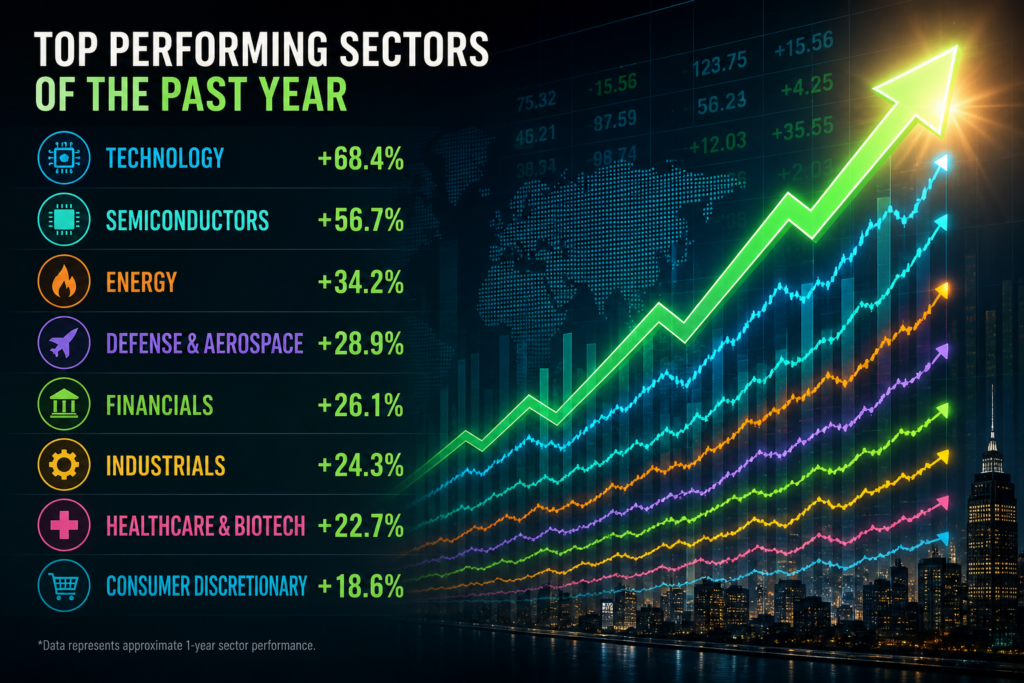
Where the Money Moved: The Top-Performing Sectors of the Past Year
Markets rarely move as one. Beneath the surface of the major indices, entire sectors surge, stall, or collapse—driven by shifts in technology, policy, geopolitics, and psychology. Over the past year, the story wasn’t just about gains. It was about concentration, momentum, and the relentless search for the next edge.
While broad indices delivered solid performance, a handful of sectors dominated returns—pulling capital toward them like gravity wells. These weren’t random moves. They were fueled by narratives that turned into real money, fast.
Here’s a deep dive into the sectors that led the charge—and why.
1. Technology & Artificial Intelligence – The New Gold Rush
No sector captured attention—and capital—like technology, particularly anything tied to artificial intelligence. The explosion of demand for AI infrastructure pushed companies like NVIDIA into historic rallies. Data centers, chips, cloud computing—every layer of the AI stack surged.
This wasn’t just hype. Corporations across industries began pouring billions into AI capabilities, creating real demand for hardware and software. The result? Revenue growth that justified valuations many once called absurd.
Investors weren’t just buying stocks. They were buying into a belief: that AI is not a trend, but a foundational shift—comparable to the internet itself.
2. Semiconductors – The Backbone of Everything
Closely tied to AI, semiconductors became one of the strongest-performing sub-sectors. Companies like AMD and TSMC benefited from surging demand for advanced chips.
But the story goes deeper. Chips are no longer just part of the tech world—they are the infrastructure of modern civilization. From cars to weapons systems to smartphones, everything depends on them.
Geopolitics added fuel to the fire. Supply chain concerns, U.S.-China tensions, and national security priorities turned semiconductors into strategic assets—not just business opportunities.
3. Energy – Quiet Strength Behind the Noise
While tech grabbed headlines, energy delivered strong returns with far less noise. Traditional oil and gas companies, along with energy infrastructure firms, benefited from stable demand and controlled supply.
Companies like ExxonMobil posted strong earnings, supported by disciplined production and favorable pricing environments.
At the same time, the global energy transition created a dual dynamic: fossil fuels remained essential, while investments in renewables continued to grow. This tension kept capital flowing into the sector.
Energy didn’t need hype. It had cash flow.
4. Defense & Aerospace – Profit in Uncertainty
Geopolitical instability has a way of redirecting money. Over the past year, defense and aerospace companies saw increased demand as global tensions remained high.
Firms like Lockheed Martin and Northrop Grumman benefited from rising military budgets across multiple countries.
Conflicts, strategic rivalries, and a renewed focus on national security turned defense spending into a priority. Investors followed the money.
It’s a sector driven not by innovation cycles—but by fear, strategy, and long-term contracts.
5. Financials – Riding the Rate Wave
Banks and financial institutions experienced a volatile but ultimately profitable year, shaped largely by interest rates. Higher rates expanded net interest margins, allowing many banks to increase profitability.
Institutions like JPMorgan Chase demonstrated resilience, benefiting from scale and diversified operations.
However, the sector wasn’t without stress. Regional bank concerns and liquidity fears created moments of sharp volatility. But for the strongest players, these disruptions became opportunities.
Financials reminded investors of an old truth: when money becomes more expensive, those who control it often win.
6. Industrials – The Return of Physical Economy
After years dominated by digital growth, the industrial sector made a powerful comeback. Infrastructure spending, reshoring of manufacturing, and global supply chain adjustments boosted companies involved in construction, machinery, and logistics.
Firms like Caterpillar saw increased demand as governments and corporations invested in real-world assets.
This wasn’t just recovery—it was a structural shift. Countries began prioritizing domestic production and resilience over efficiency alone.
The physical world, long overshadowed by tech, came roaring back.
7. Healthcare & Biotech – Innovation With Volatility
Healthcare had a mixed but notable year. While not always leading in headline returns, specific areas—especially biotech—delivered explosive gains.
Companies involved in cutting-edge treatments, gene editing, and weight-loss drugs saw massive investor interest. Breakthroughs translated quickly into valuation spikes.
However, this sector remains highly volatile. Success depends on clinical results, regulatory approvals, and long timelines.
Still, when it works—it works fast.
8. Consumer Discretionary – Selective Strength
Consumer spending remained surprisingly resilient, supporting segments of the discretionary sector. Companies with strong brands and pricing power performed well, even in the face of inflation.
Amazon, for example, benefited not only from retail strength but also from its cloud business, blending consumer and tech exposure.
However, the gains were uneven. Not all consumer companies thrived—only those able to adapt quickly to changing behavior.
This was a stock-picker’s sector, not a broad rally.
The Hidden Pattern: Concentration of Power
If there’s one theme that defines the past year, it’s concentration. A relatively small group of companies—and sectors—drove a disproportionate share of market returns.
This created a paradox: markets appeared strong, but beneath the surface, leadership was narrow.
For investors, this raises critical questions:
Is this sustainable?
Or is it a setup for rotation?
What Comes Next?
Markets are cyclical. The sectors that dominate one year rarely dominate the next in the same way. Capital moves. Narratives shift.
Technology and AI may continue to lead—but valuations matter. Energy could remain stable—but dependent on macro conditions. Defense may grow—but tied to geopolitics.
The real edge lies not in chasing what already moved—but in identifying what’s about to.
Final Thought
The past year wasn’t just about returns. It was about understanding where the world is going—and placing bets accordingly.
Because in markets, just like in life,
the biggest rewards don’t go to those who follow the trend—
but to those who see it early… and move before everyone else.
 The Catholic Fast-Fashion Trust -Brenninkmeijer family
 The Concrete Crown And The Moraes Dynasty