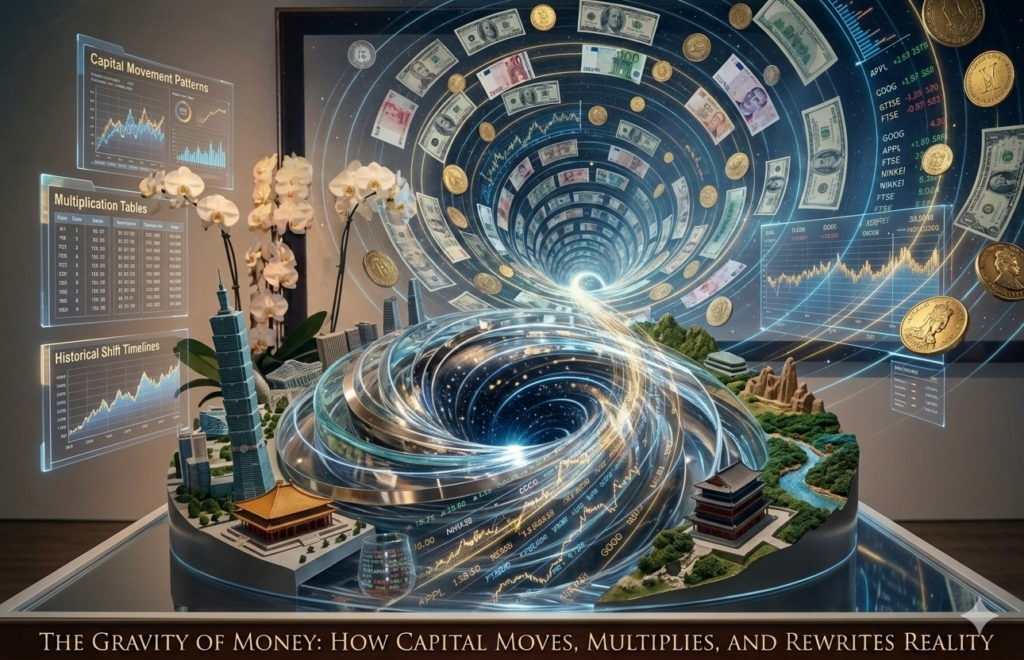
Money is not just numbers.
It is movement.
It flows, concentrates, expands—and sometimes disappears without warning.
Most people see money as something to earn.
A smaller group sees it as something to grow.
But a rare few understand what it really is:
A force.
And like any force, it follows laws.
Invisible laws. Psychological laws. Structural laws.
Once you understand them, money stops being random—and starts becoming predictable.
1. Money Flows Toward Momentum
Capital is not loyal.
It doesn’t care about fairness, effort, or history.
It moves toward momentum.
When something starts working—whether it’s a stock, a sector, a company, or even a narrative—money piles in. Not gradually, but aggressively.
This is why markets often look irrational:
- Good companies stay ignored
- Strong trends become stronger
- Bubbles form… and keep growing
It’s not logic. It’s flow.
Investors don’t just buy value.
They chase movement.
And once momentum begins, it feeds itself.
2. Wealth Compounds Quietly
The most dangerous thing about money is how slowly it starts… and how fast it ends.
Compounding is invisible in the beginning.
Almost boring.
But over time, it becomes explosive.
Take someone who earns 10% annually:
- Year 1: nothing impressive
- Year 5: noticeable
- Year 10: powerful
- Year 20: life-changing
The problem?
Most people quit before it gets interesting.
They chase faster gains.
They interrupt the process.
But those who understand compounding treat time as their greatest asset.
They don’t rush the process.
They protect it.
3. Control Creates Wealth, Not Just Effort
There’s a hidden shift that separates average earners from those who build serious capital:
They move from effort… to control.
Effort is limited:
- You work → you earn
- You stop → it stops
Control scales:
- You own → it grows
- You delegate → it expands
This is why the richest individuals don’t focus on working harder.
They focus on:
- Owning businesses
- Controlling assets
- Building systems
They design environments where money continues to move—even when they don’t.
4. Risk Is Misunderstood
Most people fear risk.
The wealthy redefine it.
Risk is not volatility.
Risk is lack of understanding.
A billionaire will put millions into something that looks dangerous—but only because they understand it deeply.
At the same time, they will avoid things that look safe—if they don’t control them.
Real risk comes from:
- Ignorance
- Overconfidence
- Lack of liquidity
Not from movement itself.
The goal isn’t to avoid risk.
It’s to choose your risks carefully.
5. Money Amplifies Who You Are
Money doesn’t change people.
It reveals them.
If you are disciplined, money makes you powerful.
If you are reckless, money accelerates your downfall.
This is why sudden wealth often disappears.
People focus on making money…
But ignore becoming the kind of person who can handle it.
The truth is simple:
Your financial ceiling is tied to your personal structure.
Habits. Discipline. Emotional control.
Without these, money leaks.
6. Liquidity Is Power
In every crisis, one group wins:
Those who have cash.
When markets crash, when fear spreads, when assets are sold cheaply—the ones with liquidity gain control.
They buy:
- Companies
- Real estate
- Stocks
- Entire industries
At a discount.
While others panic, they act.
Liquidity is not just safety.
It’s opportunity in its purest form.
7. Information Timing Is Everything
In the modern world, information is everywhere.
But timing is what matters.
By the time something becomes obvious—it’s often too late.
The biggest gains happen:
- Before the news
- Before the trend
- Before the crowd
This doesn’t mean guessing randomly.
It means understanding patterns early:
- Technological shifts
- Economic cycles
- Behavioral changes
Those who move early get the upside.
Those who arrive late… provide liquidity.
 The Paradox of Plenty: Mir Osman Ali Khan
 the Quiet Power of Roman Abramovich