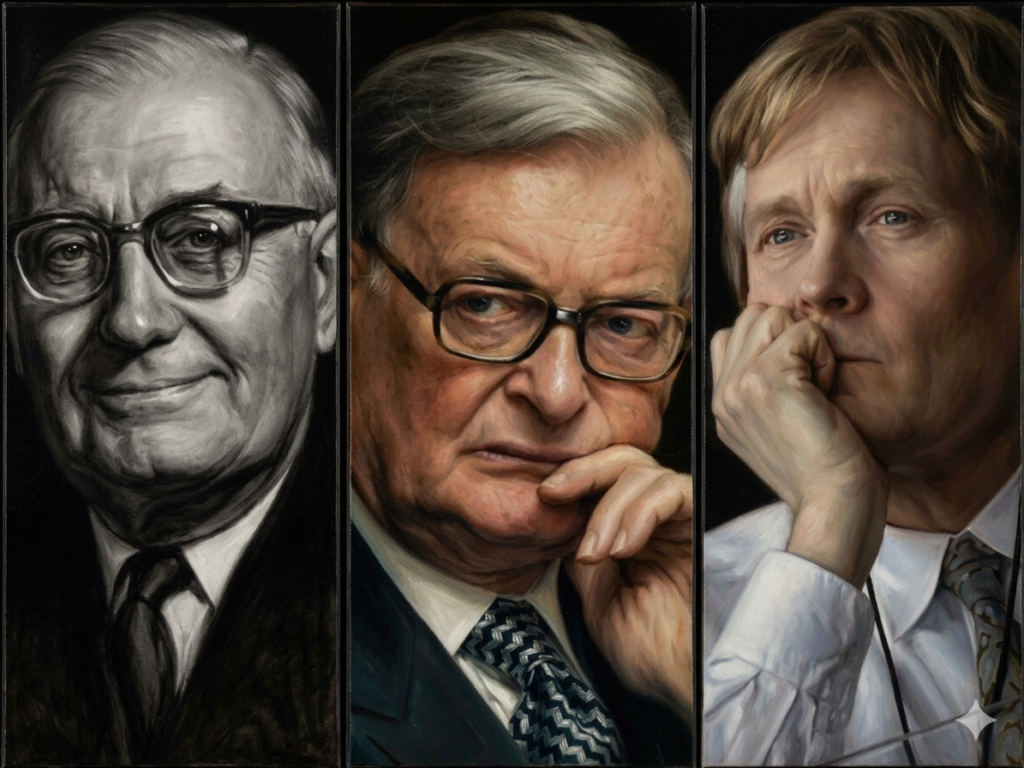
From Broke Canadian Kid to Newspaper Baron: The Real Story of Roy Thomson
If you stand in front of a big media building today and see the name “Thomson Reuters” on the door, it’s easy to forget that this whole story started with one man who basically had nothing. Roy Thomson, later known as Baron Thomson of Fleet, didn’t grow up rich, noble, or powerful. He grew up hustling. And that’s exactly what makes his path into the British nobility so interesting.wikipedia+2
This isn’t a fairy tale about an old aristocratic family. It’s a very modern story: a poor kid from Toronto who turned small, failing businesses into a global information empire, and along the way was rewarded with a title in one of the world’s oldest aristocracies.britannica+2
The early days: no silver spoon, just work
Roy Herbert Thomson was born in Toronto in 1894. His parents were Scottish immigrants and there was nothing glamorous about his childhood.broadcasting-history+1
He left school early and took whatever work he could get – including a job in a coal yard – because his family needed the money.scribd+1
Over the years he tried different small businesses. One of the first bigger ones was a car parts business that by the mid‑1920s was already bringing in serious revenue, but it wasn’t a smooth, straight line to success.scribd
He failed more than once, and that’s an important part of his story: he didn’t become a “baron” by finding one magic idea. He just kept moving, adjusting, and trying new things.
By 1931, he opened a radio station, CFCH, in North Bay, Ontario.broadcasting-history+1
Radio was still a young medium, and he understood something simple but powerful: if you control the channel through which information flows, you control a lot more than just ad revenue. You control attention.
The first newspaper: buying what nobody else wants
The real turning point came in 1934, when Thomson bought his first newspaper, the Timmins Daily Press in northern Ontario.matrixbcg+2
This wasn’t some glamorous national title. It was a small paper in a mining town. But Thomson had a habit that made him dangerous in the best business sense: he liked buying things other people didn’t value.
The pattern that made him rich is very simple to describe and very hard to copy:
- He looked for underperforming assets – newspapers and businesses that weren’t doing well.bbc+2
- He bought them relatively cheaply.
- He cut costs, tightened management, improved operations and advertising, and turned them back into profitable machines.thomsonreuters+1
It sounds almost boring, but this “buy, fix, repeat” loop made him a powerful figure in Canadian media. By the early 1950s, he owned 19 newspapers and was president of the Canadian Daily Newspaper Publishers Association.wikipedia+2
From there, he kept going – not by inventing some flashy product, but by repeating a disciplined strategy over and over: spot value where others see trouble, acquire, improve, and hold.portersfiveforce+1
Crossing the ocean: the “wild colonial boy” in Fleet Street
In the mid‑1950s, Thomson made a bold move: he shifted his focus to the United Kingdom.wikipedia+2
He settled in Britain and started buying into the heart of the British media world. One of his first big UK media buys was The Scotsman, a respected Scottish newspaper.thomsonreuters+1
But the real game‑changer came in 1959, when he bought the Kemsley group of newspapers.britannica+3
That deal gave him control of the Sunday Times, one of the most influential newspapers in the country.wikipedia+3
The BBC later described him as a “wild colonial boy” who cut through the old, family‑owned British newspapers.bbc
What they meant was that he didn’t play by the old, polite rules of London’s traditional press barons. He was direct, persistent, and very commercial. According to accounts from people who knew him, he had a habit: every time he met another newspaper owner, he would ask if their paper was for sale.bbc
He didn’t stop with the Sunday Times. In the 1960s he acquired The Times of London as well.wikipedia+3
Owning both titles meant he held a huge part of the British “conversation”: what the elite read on Sunday, and what they read every day of the week.
By this point, Thomson was no longer just a Canadian businessman. He was one of the biggest newspaper owners in Britain, Canada, and the United States, with more than 200 papers in his empire.matrixbcg+2
From newspapers to a full‑blown empire
Thomson didn’t limit himself to newspapers. He moved into television, airlines, and even oil and gas.wikipedia+2
He invested in Scottish Television (STV), bought an airline called Britannia Airways, and took part in North Sea oil exploration.thomsonreuters+1
Why does this matter economically? Because it shows he wasn’t just an “old media guy.” He understood that information, transportation, and energy were all parts of a bigger picture: who controls infrastructure and communications in a modern economy.portersfiveforce+2
He set up what became known as the Thomson Organization, which later evolved into The Thomson Corporation – a group that gradually shifted from mass‑market newspapers to specialized information services, legal publishing, and professional data.portersfiveforce+2
That shift – from selling papers on the street to selling highly structured information to lawyers, financiers, and governments – is the key to why the Thomson name still matters today.matrixbcg+2
So how did he become a baron?
In 1963, Thomson became a British citizen, and the following year he was made Baron Thomson of Fleet in the Peerage of the United Kingdom.britannica+1
“Fleet” in the title referred to Fleet Street, the historic home of the British newspaper industry. In other words, his title literally tied him to the street where he had become a dominant figure.wikipedia+1
This is important: he didn’t get the title because his ancestors fought in medieval wars. He got it because he controlled a big chunk of the country’s information flow and had made a massive economic and employment impact.britannica+2
In the British system, new titles like his are often described as a reward for “services to the nation.” In his case, that meant saving and expanding key national newspapers, investing in British media, and building one of the largest communications businesses of his time.bbc+2
What happened after Roy Thomson?
Roy Thomson died in 1976, but his family didn’t disappear with him.wikipedia+1
The title and much of the business passed to his son, Kenneth Thomson, who continued to grow the company and eventually became one of the richest men in the world.matrixbcg+1
Under the second generation, the Thomson group pulled back from running British national newspapers and focused more on information and publishing businesses.wikipedia+1
They sold The Times and the Sunday Times in the early 1980s and poured their energy into building a global information company, buying up legal publishers and data providers.wikipedia+1
A key deal was the purchase of the US legal publisher West in the 1990s, which anchored Thomson’s position in legal information.portersfiveforce
Then, in 2008, the Thomson side merged with Reuters, the historic news‑wire founded in 1851, to form Thomson Reuters – today a giant in legal, tax, and financial data and news.portersfiveforce+2
Roy’s grandson, David Thomson, became chairman, and the family remains extremely wealthy and influential, especially in Canada.bbc+2
So if you’re wondering whether the title “Baron Thomson of Fleet” still has economic meaning today – the answer is yes. Behind the title stands a real corporation, real cash flow, and a real seat at the global information table.
What was his “secret” – and what can we learn from it?
When you look at Roy Thomson’s life from a business point of view, his “secret” isn’t magic. It’s a set of habits:
- He bought unfashionable assets – small‑town papers, fading titles, businesses in trouble.britannica+2
- He improved operations rather than chasing hype.
- He understood the long‑term value of controlling information streams, whether through radio, newspapers, or data services.bbc+2
- He was relentless. People remembered him as the man who always asked, “Is your paper for sale?”bbc
In a world obsessed with instant unicorns and viral apps, Thomson’s story is almost old‑school: look for boring businesses that matter, pay a sensible price, manage them well, and repeat for decades. That’s how a guy who once worked in a coal yard ended up in the House of Lords.broadcasting-history+2
Economically, his life is a case study in compounding: not only compounding money, but compounding influence. Each newspaper he bought made the next deal easier. Each successful turnaround gave him more credibility with banks, governments, and sellers.thomsonreuters+3
A modern kind of nobility
Compared to old noble families who built power on land and armies, Roy Thomson represents a new type of nobility: the nobility of information and capital.wikipedia+2
His “estate” wasn’t a castle and thousands of acres; it was a network of printing presses, radio towers, news‑rooms, and later data centers and software.matrixbcg+2
Today, when you see the Thomson name on a financial terminal or a legal database, you’re looking at the long shadow of that first small‑town paper in Timmins and a man who never stopped asking if the next asset was for sale.wikipedia+2
That’s the real economic value of his legacy: he showed that in the modern world, if you understand information, and you’re patient and disciplined about what you buy, you can start with almost nothing and still end up with a title that once belonged only to warriors and landlords.
 The Gum Empire And The Shin–Shigemitsu Clan
 The Local Empire Bid – Hoffmann Family