A Patriarch In Brown And Grey
Family Origins: Wilhelm, Marie And The Finck Siblings
August was born in 1898 in Kochel am See to banker Wilhelm von Finck (1848–1924) and Marie Fäustle (1865–1935). He had two sisters and a brother, Wilhelm von Finck Jr. (1893–1916), who was killed in action during World War I, after which August himself served in the German army in the Balkans.
Upon Wilhelm’s death, August stepped into his father’s role as principal partner at Merck Finck, inheriting both corporate control and extensive landed property. The Finck name thus moved from founder generation to an heir already embedded in German high finance, just as the Weimar era was sliding toward crisis.
“Where most families inherit a house, the Fincks inherited Allianz and Hitler’s bank.”
Dark Money AnalysisTwo Marriages, Five Children: Mapping The Clan
Von Finck married Margot von Rücker in 1927; they remained married until their divorce in 1942. With Margot he had three children: Wilhelm von Finck (1927–2003), August von Finck Jr. (1930–2021) and Eleonore Grziwa, née von Finck (1931–2014).
In 1953 he married his second wife, Dr. Gerda Mau, with whom he had two more sons: Gerhard von Finck (born 1954) and Helmut von Finck (born 1959). These five children form the core of the postwar Finck dynasty, with August Jr. in particular becoming the face of the family’s wealth in late‑20th‑century Germany.
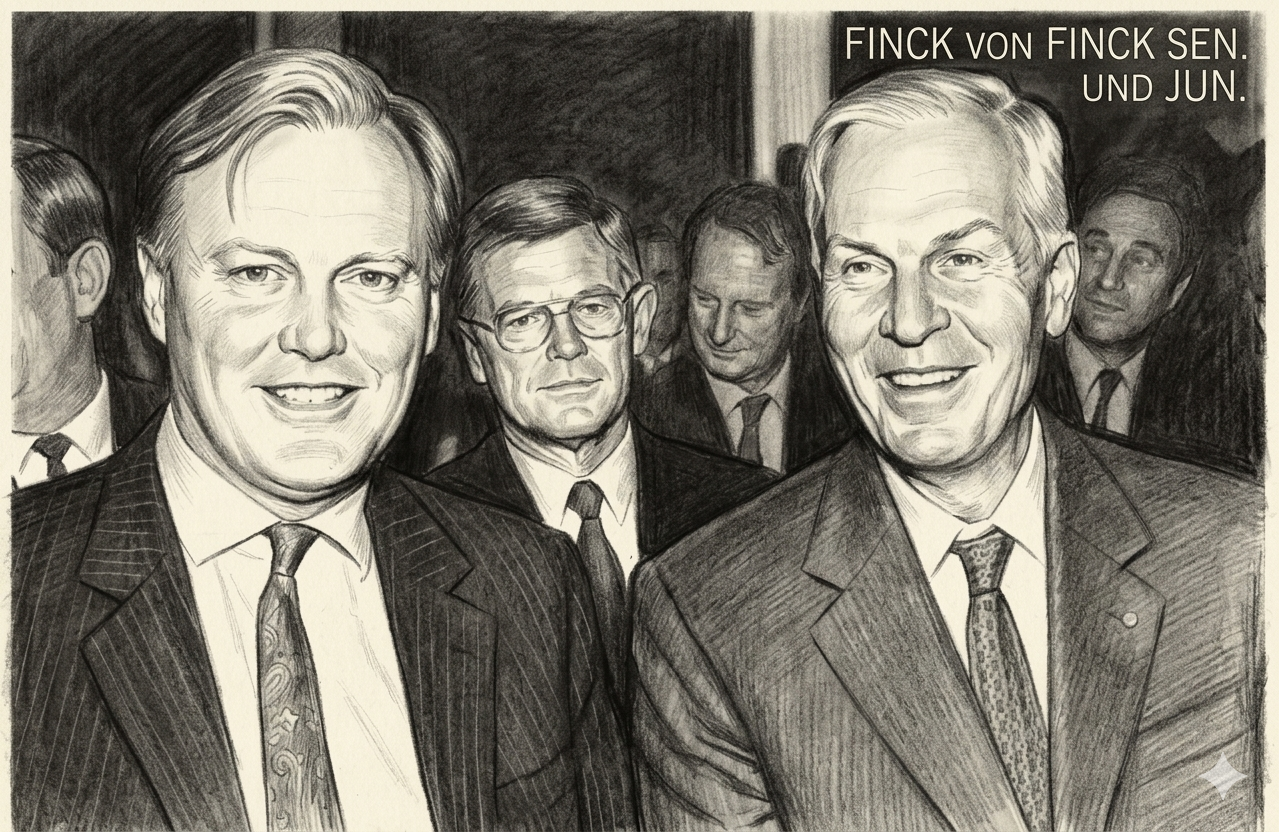
A 2010 Wirtschaftswoche piece on the “Finck clan” (cited in the article) describes internal legal battles over the billion‑euro inheritance among these descendants after August Jr.’s era, underscoring how the Sr. generation’s Nazi‑era gains remained a live asset decades later.
Nazi Era: Aryanisation As Family Business Model
August joined the Nazi Party (NSDAP) in May 1933 and became a key banker for the regime. Between 1933 and 1938 he advocated and profited from Aryanisation, leading hostile takeovers of Jewish‑owned firms in Germany and annexed Austria, including the Vienna Jewish bank S. M. von Rothschild, sold to Merck Finck at a very low price.
He wrote to a Chamber of Commerce in 1937 that “the gradual cleansing” of private banking from the “Jewish element” should be “promoted by all means,” and Allianz flourished during the war thanks to cultivated ties between the NSDAP and Finck. In photographs from 1935 he appears performing the Nazi salute at the topping‑out ceremony of the Haus der Deutschen Kunst alongside Hitler, visually anchoring the family’s role in regime prestige projects.
“For the Fincks, Aryanisation was not an episode; it was a core revenue line.”
Dark Money AnalysisPostwar Denazification And Quiet Rehabilitation
After 1945, von Finck withdrew formally while a trustee managed Merck Finck during denazification. He presented himself as apolitical and even anti‑Nazi, submitting around forty Persilschein (character references) to the court and spending 500,000 Deutsche Mark to influence witness testimony, according to sources cited in the article.
In 1948 he was classified only as a “fellow traveler” of the Nazis and ordered to pay 2,000 marks to a restitution fund, a decision he appealed before obtaining amnesty. He was barred from banking for five years, then returned in 1951 to rebuild Merck Finck & Co., taking what sources describe as a conservative course and campaigning against land reform.
Investigative pieces in WSWS, The Jerusalem Post and De Jong’s book “Nazi Billionaires” (all cited) portray von Finck as emblematic of Nazi‑era business elites who largely kept their fortunes and re‑entered postwar high society with limited penalties.
Assets, Castles And The Next Generation’s Base
In 1972, August Sr. bought Weinfelden Castle in Switzerland from a Jewish family for 340,000 Swiss francs and renovated it. The article notes that the castle is now inhabited by his son August von Finck Jr., making it both a symbolic and literal seat of the modern Finck line.
By the late 20th century, reporting in Fortune and other outlets cited in the notes traced how the family’s holdings, anchored in Merck Finck, Allianz stakes and diversified investments, made the Fincks one of Germany’s wealthiest clans. August Jr., Gerhard and Helmut carried this wealth into new vehicles, including stakes in breweries, luxury hospitality and right‑leaning political causes, as detailed in external sources linked from the article.
“From Aryanised banks in Vienna to a Swiss castle for August Jr., the asset trail stays inside the family perimeter.”
Dark Money AnalysisFamily Tree: Children And Their Lines
The article lists the five children without detailing their descendants: Wilhelm (1927–2003), August Jr. (1930–2021), Eleonore (1931–2014), Gerhard (born 1954) and Helmut (born 1959). Later German‑language obituaries and business‑press pieces (referenced in the notes) discuss internal disputes among these lines over August Jr.’s multi‑billion‑euro estate.
What emerges is a dynastic split between the older branch (Wilhelm, August Jr., Eleonore) tied most closely to the original Nazi‑era assets and the younger sons Gerhard and Helmut who came of age in the Federal Republic’s boom decades. All, however, sit inside the same surname that once signed letters calling to “cleanse” German private banking of Jews.
The category tag “Finck family” and linked biographical entries show how multiple Finck descendants now appear as discrete figures in finance and politics, while English‑language coverage often compresses them back into “the Finck family” as a single economic actor.
August von Finck Sr. inherited Allianz and Merck Finck & Co., joined the Nazi Party, and used Aryanisation and war to build a private‑banking fortune, then navigated denazification to return to power and pass wealth to five children from two marriages. With August Jr. ensconced in a Swiss castle bought from a Jewish family, and the wider Finck clan still anchored in Nazi‑era gains repackaged as postwar respectability, the dynasty is a textbook case of how German oligarchic families converted collaboration into multigenerational capital — and how their surnames continue to fund political projects long after the brown uniforms disappeared.
 The Telecom Billions And The Mikati Clan
 The Nordic Pyramid – Wallenberg family